Tuesday, 22 January 2013
In praise of … Ken Stott
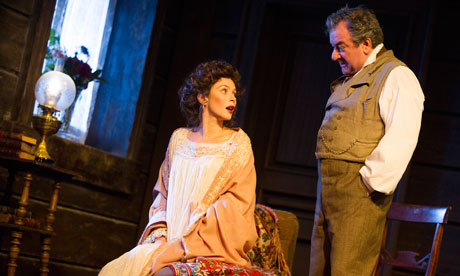
In the West End at the moment you can see Stott playing Uncle Vanya as it should be done
How to play Uncle Vanya? The question is harder than it appears. Chekhov's play is assuredly a masterpiece; his title role, however, is defined more by what he is not than what he is. Middle-aged, his life has been spent keeping up the estate of a distant, ungrateful relative. The story that unfolds is of how this "educated, intelligent" man becomes painfully aware of life's other possibilities – and how they have fallen out of his grasp. A study in frustration, then, and many actors play the role as querulous, unprepossessing. But in the West End at the moment, you can see Ken Stott do it as it should be done: bursting with rage, but also a gallows humour. From DJ Eddie McKenna to Inspector Rebus, Stott's ability as an actor has not been matched with commensurate levels of fame. And yet, whether in Yasmin Reza's Art or as Tony Hancock, he habitually mines deeper into characters than others at his level are willing to go. A grafter, a superb grafter.
Editorial: The Guardian, Sunday 20 January 2013
Source: The Guardian
Tuesday, 18 December 2012
Ken Stott on Balin ('The Hobbit' interviews)
'He’s a dwarf who’s seen too much...'
Scottish actor Ken Stott has been known not to be a particularly good fool-sufferer – he once stopped a production of A View From The Bridge to turf a group of noisy schoolkids out of the theatre – and while his dwarf, Balin, probably won't be giving the younglings of the Shire too many lessons in good manners, he will be delivering some of The Hobbit's sager moments. “He has some wisdom,” the one-time Inspector Rebus tells Empire of his character. “I’m not sure how much wisdom a dwarf has, but he has some..."

Tell us about Balin...
For a dwarf he has some wisdom. I’m not sure how much wisdom a dwarf has, but he has some. But dwarves can always make mistakes. Dwarves can get things wrong. And he gets things wrong, too. He’s the force of dignity for the dwarves. He’s worried about the whole adventure. He takes no pleasure in killing. He’s a dwarf who has seen too much of it in the past. So he does not enter the venture wholeheartedly.
Are you a Tolkien man?
I read the Hobbit at the age when you’re supposed to read it. I didn’t read The Lord Of The Rings. My father, who was an English teacher, advised me that once I had read the Hobbit, that would be enough. I could then move on to Dostoyevsky.
On set, it seemed like Peter Jackson was drawing a lot of comedy from the dwarves.
It’s hard to look at these characters and not smile.
Tell us about Peter.
Well, this project was in his mind for goodness knows how long. It has been in jeopardy for so long and we all want it to work. He has made Wellington the spiritual home for the Tolkien books and it’s great to be part of that. I’m sure no doubt it will be as beautiful and as engrossing as The Lord Of The Rings, though possibly with more humour. We’re like The Dirty Dozen. A Dirty Baker's Dozen.
Did you have any preconceptions about your look?
Like all of us, I marvelled at the artistry. But not the wearing it. The best bit of wearing it is taking it off. Because it is ghastly... utterly ghastly.
How was the dwarf training?
We wanted to establish that kind of walk – a centre of gravity. How we walked, the way we held ourselves. Walking with a slight bend in the knee and a shift in the gravity. Unfortunately, what we didn’t take into account was the sheer weight of the costumes. Stumbling and falling around are very common.
But in the end it must be an extraordinary thing to play.
Well, it’s unusual. Death Of A Salesman is a great acting job.
How is your dwarf singing?
Enchanting. We’re bringing out the single...
Do you think small?
Only when we’re with others do we think about it. When we’re with Gandalf, which is either Ian on a box or a scale double who is, you know, up there. Only then do you notice the difference.
Read More Exclusive Hobbit Content
Read a new Dwarf interview every day plus exclusive features as we count down to The Hobbit |
Interview by Ian Nathan
Source (including photos): Empire Online
Sunday, 9 December 2012
Ken Stott: 'The Hobbit' interview, 'Uncle Vanya' closing early
The Hobbit: An Unexpected Journey
Interview - Ken Stott
Source: Trailer Addict
The L A Times' Hero Complex blog has 60 photos from The Hobbit: An Unexpected Journey
Read more here
Uncle Vanya to close early in the West End
The West End production of Uncle Vanya, starring Ken Stott, Anna Friel and Samuel West, is due to close three weeks earlier than planned.
It will now run until January 26, 2013, instead of February 16, at the Vaudeville Theatre.
The show, which opened this October, is directed by Lindsay Posner and has been adapted from Chekhov’s play by Christopher Hampton.
Christopher Oram is the designer and Kim Poster has produced the show for Stanhope Productions with Nica Burns, Robert Bartner and Max Weitzenhoffer.
Source: The Stage
Sunday, 18 November 2012
Ken Stott
Uncle Vanya: review
There’s a Chekhov to suit every taste at the moment – the rambunctious Russian Uncle Vanya at the Noel Coward, the just-ended Three Sisters at the Young Vic, Anya Reiss’s new translation of The Seagull opening at the Southwark Playhouse next week, and this pared-back Uncle Vanya from Lindsay Posner at the Vaudeville. It will not be to everyone’s taste, certainly, but I found it affecting and enjoyable.
Posner’s version is very funny but neither loses nor glosses over the deep-rooted melancholy and ennui at the heart of the play. Christopher Hampton’s script is a rather lovely thing, nuanced and witty without losing the odd directness with which all of Chekhov’s creations speak. Posner’s staging is rather more naturalistic than the script sometimes allows, and the cast imbue Hampton’s words with the crushing weight of depression alongside the chit-chat and teasing that goes on amongst close companions.
Christopher Oram’s rather boxy, austere set will also divide the critics, I suspect, but I adored it. Beautifully, delicately lit by Paul Pyant, the placement of furniture and actors amongst heavy, dark wooden beams and walls had the stilted, confined beauty of a still life. Somehow, between them, Oram and Pyant have pinned down the subtlety and stillness of a Vermeer on a West End stage, and it is truly remarkable to watch. Their design is also oppressive, reinforcing how listless and trapped all of the characters are.
As a piece of theatre, however, it doesn’t always hang together. With not a lot of actual plot to depend on to move the action along, this production occasionally languishes with its characters in the slow, lazy, dull days. This is a dangerous move for a director, and there are times when the audience, too, are likely to become listless and fidgety. The middle of Act Two drags, as does the beginning of Act Three. Chekhov places almost all of the meat of the play – the one action scene – at the end of Act Three which means an awful lot of exposition in the build-up. What felt slightly misjudged, to me, was the way Posner builds tension in the second act, which instead of climaxing rather fizzles out into the interval.
Samuel West’s brooding Doctor Astrov is splendid, torn between the future he imagines and wishes for for future generations, and the desires and duties that weigh upon him in the present. His relationship with the besotted Sonya (Laura Carmicheal) and the beautiful Yelena (Anna Friel) is well done – the tensions are palpable and mostly not overblown. I found Carmichael a little shrill at times, however, she plays the repressed and buttoned-up Sonya with a heartbreaking intensity when tentatively reaching for new happiness. Ken Stott, as the eponymous Vanya, conveys a deeply unhappy man with a depth that prevents the character’s more self-indulgent moments from moving from melancholy to mawkish. Friel’s Yelena is a bit limp; she moons around the stage without much purpose, although this is more a fault of the character than of the actor.
The scene changes take an inordinately long time, but the reveal is worth it every time – Oram’s sets really are a joy to behold. Posner has a solid performance on his hands, and one that mostly handles both script and plot with a deft touch. It’s not a superlative production, but the visual beauty is hard to overstate.
Uncle Vanya is at the Vaudeville Theatre until 16 February 2013.
Source: A Younger Theatre
Sunday, 4 November 2012
Ken Stott
Chekhov's Uncle Vanya: from Russia with grunge
What's the right way to do Chekhov? With lace tablecloths and endless cups of tea – or a blast of Nirvana? Stars from three new productions, including Anna Friel and Ken Stott, talk to Stephen Moss
Towards the end of the first half of the Young Vic's current production of Three Sisters, there is a spirited rendition of Smells Like Teen Spirit – in place of what should be a folk song. I happened to be sitting next to two young Russians, and one told me he thought Kurt Cobain's existential angst was a bit too obvious for Chekhov. "Some of the subtleties have been lost in this production," he said. Perhaps. I did spend the interval humming Nirvana rather than thinking about the plight of the Prozorov sisters.
What constitutes a truthful performance of Chekhov? The question arises because this in-your-face (to use my Russian's term) production – which is playing to full houses in London – precedes a contrasting pair of Uncle Vanyas in the West End. One is directed by the much-garlanded Lindsay Posner and has a starry cast, including Ken Stott, Anna Friel and Sam West; the other, by the Moscow-based company Vakhtangov, promises to make the Young Vic production look, if anything, rather tame.
Vakhtangov, in their press release, poke fun at how Chekhov is often staged here: it's like Downton Abbey reworked by Dostoevsky, they imply, vowing to brush away the cobwebs with their version: "There's no Chekhovian mansion, no cosy armchairs, no table laid for lunch, with a lacy tablecloth and hot samovar [tea urn]; no feeling of 'home' where several generations have lived." Instead, we are promised a "battlefield of passions, broken illusions and unrealised hopes".
It is certainly one way of looking at this story of a middle-aged drudge, Vanya, whose life in the countryside is turned upside down by the arrival from the city of his bombastic brother-in-law and his much younger wife. The director, Rimas Tuminas, tells me via email: "I have eliminated all those valenki [felt boots] and galoshes, the samovar and the old clock. It is all useless. Through an actor, I can send the audience wherever I want. While everyone is there to drink their tea, life is breaking to pieces – and that is what must be staged. I am not fond of decor changes."
For all its Nirvana and radicalism, there is plenty of tea in the Young Vic's Three Sisters. This may underline director Benedict Andrews' point that despite its apparent impertinences (Ab-Fabbish Masha, shellsuited Andrey, a Natasha with an Australian accent, a fusillade of F-words), his production is still true to Chekhov. "It's faithful beat by beat," he insists. "My notion of fidelity is about getting close to the raw nerves of the characters. The play was about contemporary people when Chekhov wrote it, and I wanted it to be about people as they are today." By moving it to the present – to avoid it becoming "museum theatre" – he hopes to make the image of a society standing on the brink of revolution resonate with our own experience of living in post-financial meltdown.
When I meet Posner to talk about his Vanya, I immediately put the great samovar question to his cast. They say it will take its rightful place in what will be a more literal Chekhov than the other two. "Well, it is in the script," argues West. "And it was there in the very first production Chekhov did," adds Friel. "You don't have to have silver birch trees with sun-dappled lighting coming through," says West. "But you do have to have a samovar if people are going to talk about how cold it's got."
Friel sneezes in sympathy. "It's fine as long as you're using the stuff," continues West. "Chekhov said you shouldn't have anything on stage you don't use. He said you're not allowed to hang a musket over the fireplace in act one unless you shoot it in act four."
After spending an hour in his company, I can tell Stott will be perfect as Vanya, capturing both his world-weariness and mania. He exudes menace: you feel he could, if pushed, fire a pistol in anger. Posner is using a text by Christopher Hampton that sticks closely to the original. "I wanted something that was as faithful as possible," he says. "I'm a purist." But isn't there a virtue in reimagining so familiar a landscape? "I think one reimagines it anyway, if you approach a classic play as if it was new. Search in the right way and it will feel fresh. I've nothing against doing new versions, but I think you have to have a very good reason to do that with a great play."
Stott reinforces the point with characteristic vigour. "I remember walking past a poster for Winter's Tale," he recalls. "It said, 'Winter's Tale by William Shakespeare – adapted by David Simkin.' Adapted? So, not good enough, is it?"
Why does Chekhov resonate so much with a British audience? Is it the preoccupation with class, the society in decline, the way emotions are held in check behind ritualised actions until they suddenly burst? Or is it just a love of costume drama, the Downton Abbey syndrome? "I'd have thought the period dress is the least of those reasons," says Posner, "but the first two are quite pertinent."
"We do feel Chekhov has a sensibility that is peculiarly English," says West, but he never gets to develop the point because Stott talks over him. "It drives me absolutely stark raving fucking bonkers that Chekhov seems to have been commandeered by middle-class Englishness," says the Scot. "I don't know why. 'Oh Chekhov, yes, that's us, you know.'" He says this in a mock-English accent. "It fucking isn't you. It isn't! It doesn't belong to the English middle class. In fact, quite the opposite – whatever is the opposite of the English middle class."
The English, adds Posner, are accustomed to a subtext of repression and bleakness. "But you don't find that in Chekhov," he says. "Chekhov's rather front-foot. The characters often aren't aware of what they're doing and saying, but that's different from holding it in." They're not displaying boredom, Stott argues, but anxiety: "If you play it as English middle-class boredom, you've got a firm grasp of the wrong end of the stick."
"It's not lethargic and it's not elegant," says Posner. "It's something else."
"Something spiky," adds Stott, spikily.
"There is a life of the soul in Russia that doesn't exist in England," continues Posner; his cast are searching for that soul, for the Russianness of their characters.
Friel, who turned down lucrative film work in the US to appear in Vanya, is approaching things in a way that would please Konstantin Stanislavsky, who directed the play's Moscow première in 1899. She visited Moscow, went to the Chekhov Museum, and tells me to read About Chekhov, Ivan Bunin's memoir of his friend, which she says movingly portrays the playwright's determination to work in the face of the tuberculosis that was to kill him at the age of 44.
While the rest of us ramble on, she texts a friend in Russia to get a native's view. Her approach to the young wife Yelena, a character sometimes misplayed as flighty or exploitative, will be nothing if not thoughtful. "Chekhov asks so many questions but never answers them," she says.
I ask Posner why he was so keen to direct Vanya. "I've reached an age where I can understand the preoccupations," he says. "The challenge of its complexity and delicacy is unsurpassed. I find it more challenging than Shakespeare."
Stott recalls doing Chekhovian scenes at drama school and misunderstanding them completely: "You have to reach middle age before you can understand a play like this." West agrees: "If you are 25, life goes through every pore and there's lots of it ahead of you. But these characters are desperate because they feel life is slipping away, and they're looking for it at any level and any cost."
With some trepidation, I read them Vakhtangov's press release dismissing the English way with Chekhov. They are unabashed. "We're trying to achieve the same thing," says Posner. "But we're keeping the samovar."
• Three Sisters is at the Young Vic, London SE1, until 3 November. Posner's Uncle Vanya opens on 2 November at the Vaudeville, WC2. Vakhtangov's is at the Noel Coward, WC2, 5-10 November.
Source (including photo): The Guardian http://www.guardian.co.uk/culture/2012/oct/31/chekhov-uncle-vanya-young-vic
Review: The Telegraph
Sunday, 28 October 2012
Ken Stott: Uncle Vanya
Multiple spotlights on Chekhov’s darkness
As five stagings of ‘Uncle Vanya’ hit UK theatres in a few months, why does its existential gloom speak to us so profoundly?
In a rehearsal space in east London, actor Ken Stott is poking disconsolately at the contents of a plastic lunch box. He is clearly on a no-frills diet.
“You won’t be able to see me by Monday,” he moans.
It’s a moment that could almost have been lifted from the play he is rehearsing. Stott is playing Uncle Vanya, a grouchy old so-and-so, who, in Christopher Hampton’s version of Anton Chekhov’s 1897 original, even says of himself: “I do nothing except grumble like an old sour grape.”
Stott is in good company: his Vanya will be one of five to grace British theatres within a few months. Indeed the production, directed by Lindsay Posner, opens in the West End within days of a Russian-language performance by Moscow’s Vakhtangov company, directed by the renowned Rimas Tuminas, with leading Russian actor Sergey Makovetsky in the title role.
So why is this self-styled “cantankerous old codger” so much in the spotlight? Is it a coincidence? Or is there something in his grumpiness, self-mockery and frustration that speaks particularly to our time? And if so, why should that be?
Chekhov’s Uncle Vanya is a masterpiece: a humane, funny and heartbreaking study of wasted potential. But boil it down and you end up with something as dull-sounding as suet pudding. It opens on a run-down rural estate painstakingly maintained by Vanya and his niece Sonya. We first meet the local doctor, Astrov, complaining about the tedium of provincial life, and then encounter Vanya who, at 47, is undergoing a mid-life crisis of epic proportions, kick-started by the arrival of his brother-in-law, a pompous professor, and his beautiful wife. Nearly everyone feels sorry for themselves – particularly Vanya. So why do we warm to him so?
Makovetsky thinks the appeal lies in recognition. “All of us are Uncle Vanyas,” he says. “Most people who see the performance say that it is about them.”
Stott agrees. “Most of us spend the vast majority of our time complaining about something,” the actor says. “And everyone reaches the stage where they become preoccupied with what is going to happen in the second half of their lives. In this play everyone is in a crisis about that.”
Vanya’s crisis is specific: he has spent his life maintaining the estate in order to support the professor’s career. But when the tetchy academic arrives in person, Vanya suddenly feels a fool. He senses that he has wasted 25 years servicing an opinionated charlatan. Iain Glen, who played Vanya this spring, suggests that his predicament, though particular, is universally recognisable.
“I think Vanya is particularly poignant for middle-aged people who suddenly think: ‘How do I find myself here?’ ” he says. “Nearly all the characters are suddenly brought to a point where they begin to ask themselves those life questions. ‘Why did I make that choice, why have I ended up with this person, where did the time go?’ ”
What is also important is the fact that this introspection strikes at a moment of enforced indolence. Like most of us, Chekhov’s characters start to brood when they are tipped out of their normal work routine.
“One misconception about Chekhov is that his characters were idle sort of people with not enough to do,” says Glen. “That’s certainly not what Vanya’s about. These are people who are usually very, very busy, and then something happens and they grind to a halt. It’s the arrival of this professor: the way he wants to live his life is completely at odds with the way the house has been run. Everyone is brought to a halt and in that halt starts to look inward to where they are.”
But while the frustration may be general, it is Vanya who is singled out in the title – and as “Uncle” Vanya. It’s an affectionate appellation, but not one designed to confer heroic status. It draws attention to the unfulfilled potential in his life: Vanya is not a father, grandfather, husband or lover.
“He’s only uncle to one person,” says Glen. “But he is that figure within the Russian household who kind of looks after things: the worker, the person who they could all depend on. He becomes unpredictable and undependable and inconsolable and it throws everyone’s world upside down.”
But does the play’s current popularity arise only from its timeless qualities? Or does this emotional tumult feel particularly pertinent for a 21st-century audience facing a precarious future and the loss of old certainties? Tuminas, director of the Vakhtangov’s Vanya, suggests that this might in part be true. “People nowadays are very desperate,” he says.
Tuminas describes a disorientation in Russia: “The main feeling is the loss of a dream. I agree with the great Russian philosopher who said that a country is defined not by its geographical location or by the language of the nation but by whether it has its dream or not. Liberty and democracy were once a dream for us but it hasn’t been eternal.”
Tuminas’s production is groundbreaking. Wildly physical, darkly comic and gleefully absurd, it dispenses with all the usual Chekhov furnishings. His characters rattle about on a near-empty stage, propelled by their feelings. “It’s a physical realisation that time is slipping through your fingers,” he says.
The American Richard Alger is co-director of Theatre Movement Bazaar’s Anton’s Uncles, which toured Britain earlier this autumn. He too feels the resonance of the panic in Chekhov’s play. “I think the idea of not fulfilling your dreams is very big in the Zeitgeist,” Alger says. Anton’s Uncles strips down the original, emphasising its wild fluctuations of mood. “You’re left with something very raw and that’s what’s appealing about his work,” he says.
It’s not just what Chekhov says that feels fresh then – it is how he says it. Recent English productions have shaken off the reverent melancholia of earlier stagings and embraced the emotional rawness and trapped, febrile energy in the play. When the characters soliloquise, we seem to listen in on their thoughts. Stott says this demands truthful delivery: “You have to be doubly careful to try and achieve that nakedness: stripping off a layer and showing the soul.”
Posner, his director, adds: “It’s not the plot that’s dynamic. The journey of the characters is the source of dramatic tension.”
In its earliest form, the play incorporated a suicide and a happier ending. But Chekhov changed this for a failed shooting and a more ambivalent ending: Vanya and Sonya return to their labours in a final scene that contains both solace and aching sadness. His characters may despair, but in the end they keep on keeping on. Less dramatic, perhaps, but far truer to most people’s experience.
In the end it is this profound, sympathetic honesty that speaks to us. “People always have the sense that life is just slightly better over there,” says Iain Glen. “There are very few of us who think, ‘You know what, I’m really happy right here: this is perfect.’ That’s not what we are. And that’s what Chekhov wrote about.”
‘Uncle Vanya’, Vaudeville Theatre, London, to February 16, www.unclevanyatheplay.com
‘Uncle Vanya’, Noel Coward Theatre, London, November 5-10, www.delfontmackintosh.co.uk
Source: Financial Times (Theatre & Dance)
Monday, 8 October 2012
The Hobbit: new artwork and poster
New banner artwork and White Council poster for The Hobbit: An Unexpected Journey
There's just over two months to go until Peter Jackson takes us back to Middle-earth for the first of his three-part adaptation of J.R.R. Tolkien's classic Lord of the Rings prequel The Hobbit, and now the official Facebook page has released four new banners for the hotly-anticipated first installment, The Hobbit: An Unexpected Journey, which you can check out right here
Meanwhile, earlier this week a new promo poster also arrived online via Filmcells, which gives us a look at White Council members Gandalf (Ian McKellen), Galadriel (Cate Blanchett), Elrond (Hugo Weaving) and Saruman (Christopher Lee) meeting in Rivendell.
The Hobbit: An Unexpected Journey stars Martin Freeman in the lead role as Bilbo Baggins, along with a huge ensemble cast that includes Richard Armitage, John Bell, Jed Brophy, Adam Brown, John Callen, Billy Connolly, Luke Evans, Stephen Fry, Ryan Gage, Mark Hadlow, Peter Hambleton, Barry Humphries, Stephen Hunter, William Kircher, Evangeline Lilly, Sylvester McCoy, Bret McKenzie, Graham McTavish, Mike Mizrahi, James Nesbitt, Dean O’Gorman, Lee Pace, Mikael Persbrandt, Conan Stevens, Ken Stott, Jeffrey Thomas, and Aidan Turner. Also reprising their roles from The Lord of the Rings trilogy are Orlando Bloom as Legolas, Ian Holm as the elder Bilbo Baggins, Elijah Wood as Frodo Baggins and Andy Serkis as Gollum.The Hobbit: An Unexpected Journey is released on December 14th, while The Hobbit: The Desolation of Smaug opens on December 13th, 2013 and The Hobbit: There and Back Again concludes the saga on July 18th, 2014.
Source (with poster and artwork): Flickering Myth
Scottish quote of the week: Billy Boyd on Hobbits and Scots
Scottish actor Billy Boyd was born in 1968 in Glasgow and is best known for playing hobbit Peregrin “Pippin” Tookin in the film adaptations of J.R. Tolkien’s The Lord of The Rings series.
Boyd worked as a bookbinder for several years before embarking on his acting career, and one of the books he bound was The Lord of the Rings.
The films were shot in director Peter Jackson’s native New Zealand, a country whose landscape is often compared to that of Scotland, and many of whose people are descended from Scots, lending an extra dimension to Boyd’s comparison of Scottish people and hobbits:
“Hobbits are a lot like Scots. It’s all about nature and enjoying their land, which is a very Scottish thing” – Billy Boyd
Source: The Scotsman
Sunday, 30 September 2012
The Hobbit - new poster
Dwarves, dwarves, dwarves... Eat your heart out Snow White, you've got nothing on Peter Jackson & the new Hobbit poster
There are no Sleepys, Dopeys or Docs here either. Led by Thorin Oakenshield (Richard Armitage, centre), the dwarves are (in no particular order) Fili (Dean O'Gorman), Kili (Adian Turner), Oin (John Callen), Gloin (Peter Hambleton), Dwalin (Graham McTavish), Balin (Ken Stott), Bifur (William Kircher), Bofur (James Nesbitt), Bombur (Stephen Hunter), Dori (Mark Hadlow), Nori (Jed Brophy) and Ori (Adam Brown).
Arriving unannounced at Bilbo Baggins's cottage, they whisk the Hobbit off on a quest to claim back their home The Lonely Mountain from the dragon Smaug (voiced by Benedict Cumberbatch).
The Hobbit: An unexpected Journey is released in the UK on 14 Decemeber 2012.
Source: Radio Times
Sunday, 23 September 2012
'The Hobbit: An Unexpected Journey' trailer and cast portraits
See more cast photos at Hit Fix's extensive galleries here and here
"The Hobbit: An Unexpected Journey" hits theaters on December 14.
Source: Hit Fix
Also reported by LA Times and We Are Movie Geeks
Sunday, 15 July 2012
Stunning Panoramic Poster For Peter Jackson’s ‘The Hobbit: An Unexpected Journey’
Warner Bros has unveiled, via Entertainment Weekly (check it out in its full “scrolling banner” format here), an excellent panoramic banner for the first-part in Peter Jackson’s two-part movie adaptation of J.R.R. Tolkien’s ‘The Hobbit,’ ‘The Hobbit: An Unexpected Journey.’
The banner showcases a number of new looks at many the stories major players in Martin Freeman’s Bilbo Baggins, Ian McKellen’s Gandalf the Grey, Richard Armitage’s Thorin Oakenshield, Jed Brophy’s Nori, Dean O’Gorman’s Fili, Mark Hadlow’s Dori, James Nesbitt’s Bofur, Peter Hambleton’s Gloin, Graham McTavish’s Dwalin, Ken Stott’s Balin, John Callen’s Oin, Stephen Hunter’s Bombur, William Kircher’s Bifur, Adam Brown’s Ori, Aidan Turner’s Kili, Mikael Persbrandt’s Beorn, Cate Blanchett’s Galadriel and Hugo Weaving’s Elrond.
The two Hobbit films are set in Middle-earth 60 years before ‘The Lord of the Rings’ which Peter Jackson and his film-making team brought to the big screen in the fantastic blockbuster trilogy that culminated with the Oscar-winning ‘The Lord of the Rings: The Return of the King.’ ‘The Hobbit: An Unexpected Journey’ is set for a December 14th, 2012 release date. ‘The Hobbit: There and Back Again’ will arrive in cinemas December 13th, 2013.
Reprising their roles from ‘The Lord of the Rings’ movies are Ian McKellen as Gandalf the Grey, Elijah Wood as Frodo Baggins, Cate Blanchett as Galadriel, Orlando Bloom as Legolas, Ian Holm as the elder Bilbo, Christopher Lee as Saruman, Hugo Weaving as Elrond, and Andy Serkis as Gollum. The ensemble cast includes the likes of Martin Freeman, who’s taking on the central role of Bilbo Baggins, Richard Armitage, Evangeline Lilly, Jed Brophy, Adam Brown, John Callen, Stephen Fry, Ryan Gage, Mark Hadlow, Peter Hambleton, Stephen Hunter, William Kircher, Sylvester McCoy, Bret McKenzie, Graham McTavish, Mike Mizrahi, James Nesbitt, Dean O’Gorman, Lee Pace, Mikael Persbrandt, Conan Stevens, Ken Stott, Jeffrey Thomas, Luke Evans, Benedict Cumberbatch, Billy Connolly, and Aidan Turner.
Check out the synopsis for ‘The Hobbit: An Unexpected Journey’ below the four sections of the banner at Flicks And Bits